
Aerospace Europe Conference 2021
Aerospace Europe Conference 2021
23-26 November 2021, Warsaw
23-26 November 2021, Warsaw
13 November 2021, Palazzo Marini, Borgofranco d’Ivrea (TO)
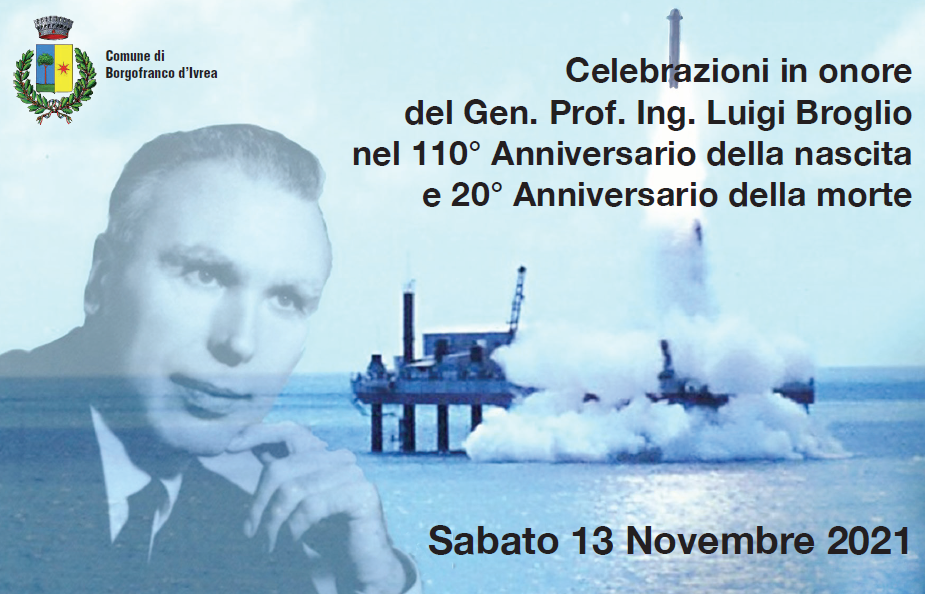
Celebrazioni in onore del Gen. Prof. Ing. Luigi Broglio nel 110° Anniversario della nascita e 20° Anniversario della morte.
14, 21, 28 JANUARY 2022, 4 FEBRUARY 2022
The webinar deals with an introduction to the world of flight simulators employed as research platforms and not exclusively as training tools. The main simulator levels, recognized by the EASA, European Union Aviation Safety Agency, will be firstly described focusing on FFS (Full Flight Simulator). Then, the main research contexts, taking advantage of flight simulators, will be presented with some referenced research activities. This will be followed by the description of research topics concerning the human factor and comfort in the simulated environments of cockpit and cabin.
Firstly, the objective and subjective techniques used to evaluate the aeronautical human factor will be described. Next, the main subjective tests for real-time and post-tasks are given, evaluating the main advantages and drawbacks. Then, objective measurement based on existing technologies will be introduced, particularly sensors exploitable inside the aircraft. Also, for these techniques, the main advantages and drawbacks will be shown. Finally, a brief overview of the mathematical correlation tools that can relate the two types of measurement data will be presented with reference to some experimental study cases.
In the second part of the course, the research topic of aviation comfort will be introduced. First, the human body’s biodynamic modelling techniques will be described with an overview of the models employed in the aeronautical framework, followed by experimental results. Finally, the analytical and numerical modelling will be shown with examples of evaluation on the human body’s comfort indexes with aeronautical manufacturers’ restrictions.
Learning objectives: Simulator classification, standards, and experimental research activities; Human Factors in cockpit and cabin environment; Human Body Comfort for pilot and passenger.
Target audience: doctoral students, non-academic professionals, and undergraduate students.
There are no registration fees for AIDAA members. In case you are not an AIDAA member, please register here.
16, 18 NOVEMBER 2021
This webinar introduces the design of orbits for Low Earth Orbit (LEO) nanosatellites and nanosatellite’s constellations to maximise local transmission or coverage capacity with a limited number of satellites. It will describe the main drivers in determining orbital evolution in Low Earth Orbit considering the perturbed two-body problem of Keplerian orbital dynamic and deriving the expression for repeated ground track and revisit time considering different coverage or visibility conditions with multiple ground stations. Finally, the webinar will present the application of orbit analysis investigations to maximise the visibility of single satellites from multiple ground stations and optimise local coverage patterns using special architectures for regional constellation design (Walker and flower constellations) aimed at continuous optical and SAR monitoring of large infrastructures.
Learning objectives:
Target audience: doctoral students interested in Earth orbit nanosat constellations design, engineers who aspire to a deeper understanding of applied orbital dynamics, technical or non-technical professionals new to the space industry who need an introduction to the problem of orbital design in LEO.
25-29 OCTOBER 2021, Dubai, United Arab Emirates
Inspire, innovate & discover for the benefit of humankind.
For the very first time, the IAC will open its doors to the global space community in the United Arab Emirates, the first Arab country to host the IAC since its establishment in 1950.
The United Arab Emirates’ interest in astronomy and space sciences dates back to the 1970’s, when His Highness Sheikh Zayed bin Sultan Al Nahyan met with the NASA team responsible for the Apollo moon landing. This encounter sparked a national focus on space that began almost three decades ago, eventually leading to the birth of a national space sector.
The IAC 2021 Host Organization – the Mohammed Bin Rashid Space Center (MBRSC) – member of the IAF since 2012, was established by the Dubai Government to serve as one of the main pillars to drive the establishment of the knowledge economy and sustainable development in the UAE.
With the theme “Inspire, Innovate & Discover for the Benefit of Humankind”, the IAC 2021 looks forward to making a contribution to humanity and to science by strengthening and enhancing cooperation between all countries in the space sector.
This is your chance to inspire the next generation, to architect the further development and expansion of the space sector’s growing ecosystem. In fact, the IAC 2021 could be your opportunity to contribute in breakthroughs that revolutionize the future of space exploration.
The IAC 2021 comes to the UAE at a fortuitous juncture: it will follow closely on the heels of the launch of the Emirates Mars Mission (Hope Probe), the Arab’s first space exploration craft to Mars. It will also mark the anniversary of the return of the first Emirati astronaut from the International Space Station, and the second anniversary of the launch of KhalifaSat — the first Earth-observation satellite to be produced wholly by Emiratis.
These achievements are symbolic of the beginning of a new era in the region; the IAC 2021 will be an opportunity to shed light on how space science and technology can contribute to a nation’s progress.
8-9 NOVEMBER 2021
Deliver robotic platforms and, in the next future, human missions on a planetary body with an atmosphere is a significant technological challenge. Onboard data acquired during Entry Descent and Landing (EDL) mission phases are typically used to verify the engineering system performances. Nevertheless, such data carry out much information of great scientific value. This webinar introduces the post-flight analysis of EDL mission data with a particular focus on the reconstruction of atmospheric profiles building upon the experience with past missions such as Huygens end ExoMars-2016 and presenting real-world case studies.
Topics:
Learning objectives:
Target audience: doctoral students, non-academic professionals, and undergraduate students.
4 NOVEMBER 2021
Small satellites are the new dominant platforms in the new space economy. Thanks to the very high capabilities of the electronic systems, small satellite, especially if working within the frame of a constellation, can provide innovative services with a cost not achievable from big satellites. However, to fully exploit their huge potential such a platform has specific need both in term of access to orbit and movement in space.
Regarding orbit access, most of the platforms fly as piggy bag on big launcher. This mean that they cannot choose the right orbit and they must fly within a schedule which is not based on their need. Around the world several companies are developing micro launchers to provide a dedicated access to space to small platforms. Micro launchers require the development of innovative propulsion systems capable to combine high performances with reasonable costs.
Once in orbit micro satellites need to reach the right altitude, the right phasing within the orbit and to maintain its position. To do it they do require an onboard propulsion system. These thrusters need to be designed to respect the reduced size of such a platform and to allow low recurring costs. Moreover, innovative missions, such as for example very low earth orbit (VLEO) require dedicated thruster to accomplish the specific mission, in VLEO for example a thruster capable of performing continuous drag compensation is required. These new scenarios open new challenges and opportunities for new innovative technology capable of reaching the right compromise between costs and performances.
Object of this webinar is to provide an overview of the ongoing market scenario related to small platforms than to provide an overview of the most innovative micro launchers developed or currently under development, and finally to provide an overview of the most promising propulsion systems suitable for small satellites developed or currently under development.
Learning objectives: market scenario, micro launchers, small thrusters.
Target audience: doctoral students, non-academic professionals, and undergraduate students.
There are no registration fees for AIDAA members. In case you are not an AIDAA member, please register here.
8-15-22-29 OCTOBER 2021
This webinar provides an overview of recent developments in sound transmission control through aeronautical panel structures. In the first part, general definitions of the sound transmission efficiency parameters are given; moreover, the classical and advanced structural models used to analyze sandwich structures are depicted. In the second part of the webinar, the attention is focused on recent industrial interests such as 3d-printed lattice materials used for the design of sandwich cores, the homogenization of the lattice material properties is introduced. Furthermore, the passive damping of the multilayered panels can be improved by using soft viscoelastic materials; therefore, their modelling with classical Kelvin-Voigt or fractional derivatives models is explained. In the last part of the webinar, the structural optimization problem is introduced; the original contributions of the authors define a new particle swarm optimization model called the Population Decline Swarm Optimization method. Finally, some case studies concerning the sound transmission control through optimized multilayered shell composite sandwich panels with lattice core embedding viscoelastic sheets are discussed.
Learning objectives:
Target audience: doctoral students, non-academic professionals, and undergraduate students.
> Download Presentation (Day 1)
> Download Presentation (Day 2)
14-17 SEPTEMBER 2021
The course aims to introduce the global-local analysis of metallic and composite structures. Advanced materials, such as composite and smart materials, are commonly used in aerospace applications. These materials can lead to local singularities that require refined models to be investigated. The course will introduce the main approaches used to increase the model fidelity locally. At first, typical global-local problems are presented and discussed. Then, a detailed overview of the main techniques proposed in academia and by commercial codes are presented. Finally, an advanced global-local approach based on variable kinematic models is introduced. Applications and numerical test cases are used to present each approach.
Learning objectives:
Target audience: doctoral students, non-academic professionals, and undergraduate students.
29/30 JUNE 2021
The aim of the webinar is to provide a synthesis and an overview of the status of the art in some areas of structural dynamics as applied in the Space Industry. The webinar is proposed by a small group of internationally recognized experts from Academia and Industry. Many topics will be investigated, as the fundamental differences between the dynamics of linear and nonlinear systems, concrete academic and industrial applications and an overview of the past effort for the development of methods and procedures for finite element model updating and validation of dynamically loaded structures.
Target audience: doctoral students, non-academic professionals, and undergraduate students.
The Italian Association of Aeronautics and Astronautics is a national non-profit cultural association, recognized as the second oldest scientific aerospace society in the world.