Courses

Courses

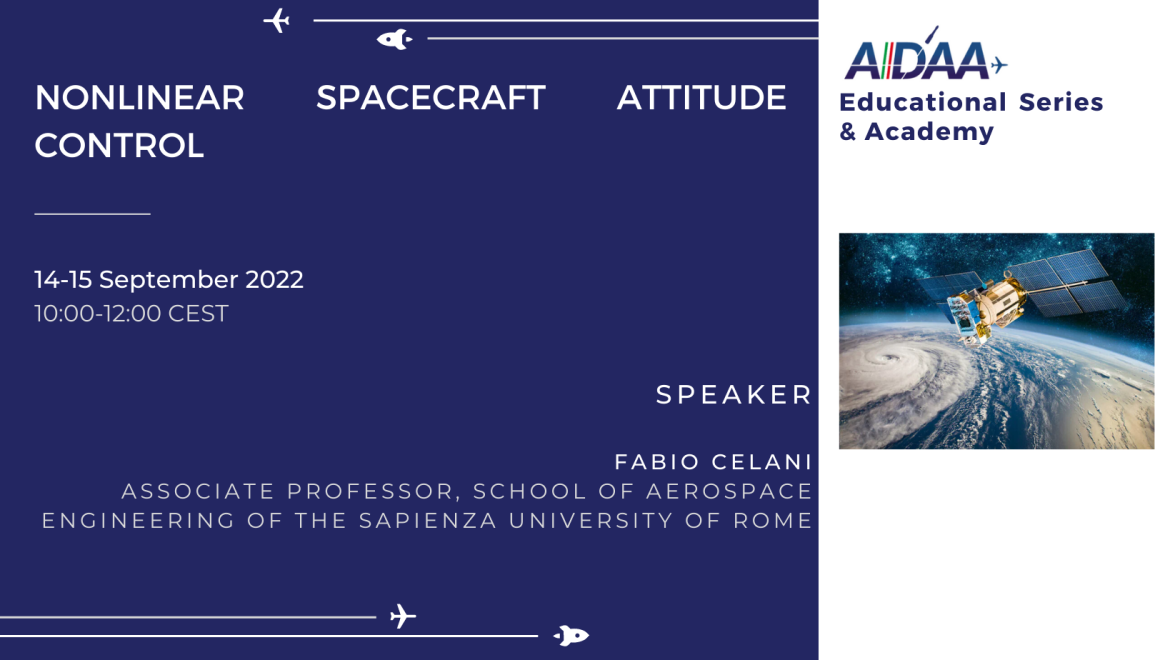
Nonlinear spacecraft attitude control

Nonlinear spacecraft attitude control

14/15 September 10-12 CEST

Spacecraft attitude control laws are often designed using linear control design techniques. As a result, their effectiveness
can be guaranteed only for small attitude angles and small angular velocities since in that situation a linear approximation
of the attitude equations can be employed. However, there are occasions when the spacecraft motion involves large
attitude angles and large angular velocities. For those motions, the full nonlinear attitude equations must be used for
evaluating the effectiveness of attitude control laws. In this course, basic results of Lyapunov stability theory will be
presented and applied to nonlinear spacecraft attitude control.

> Download Course Brochure

Participation

You need to buy one of the package list available here and use the Order ID assigned to you after purchase.
You need to Login for registration.

    Courses

    Basics of corrosion and protection of metals for aerospace

    Basics of corrosion and protection of metals for aerospace

    25 July 12-14 CEST, 15:30-17:30 CEST - 26/27 July 11-14 CEST

    Corrosion Control in the aerospace industry is becoming more critical with the aging of the aircraft fleet. In recent years, the aviation industry in terms of corrosion has been undertaken with million pounds. Corrosion control can be one of the aircraft industry’s most effective weapons in the battle against airplane structural failures. Left undetected and/or untreated, corrosion can decrease the load-carrying capacity of primary structures or act as nucleation sites for fatigue or stress corrosion cracks. Thus, corrosion can undermine the integrity of an aircraft and make it unsafe to fly. Therefore, by appropriate selection of materials, maintenance and husbandry, these effects could be decreased.

    > Download Course Brochure

    Participation

    You need to buy one of the package list available here and use the Order ID assigned to you after purchase.
    You need to Login for registration.
      Courses

      Toward Smart Air Mobility: a Model-Based Design Approach

      Toward Smart Air Mobility: a Model-Based Design Approach

      11/12 July 9-12 CEST

      The interest in Urban Air Mobility (UAM) had a steep increase over the last few years. On the one hand, the slow growth rate of ground infrastructures led to critical congestion in urban areas. On the other hand, the increasing demand for moving people and payloads further and faster drove the attention of the research community and stakeholders toward the exploitation of the vertical dimension. With the aim to play a lead role in this new raising market, electrical air platforms with vertical take-off and landing (VTOL) capabilities are being considered key elements for the next generation of controlled airspace. In such a framework, crucial but challenging steps are represented by the optimization of novel configurations and the design of Guidance, Navigation, and Control systems. In this webinar, the fundamentals of the Model-Based Design (MBD) approach will be discussed and applied to VTOL platforms. Attendees will learn the workflow of MBD and investigate the steps required for performance optimization and motion stabilization of rotary-wing vehicles. Test cases will be also presented.

      > Download Course Brochure

      Participation

      You need to buy one of the package list available here and use the Order ID assigned to you after purchase.
      You need to Login for registration.

        Courses

        High-speed civil aircraft on-board systems integration

        High-speed civil aircraft on-board systems integration

        23 May 9-11 CEST; 25 May 9-11 CEST; 25 May 14:30-16:30 CEST; 26 May 14:30-16:30 CEST

        High-speed civil aircraft may range from supersonic civil vehicles to hypersonic systems, which can be considered future civil stratospheric passenger or cargo transportations or as the first stage of reusable access to space vehicles. Integration shall be pursued at all levels, systems and subsystems as a key element of success. The webinar will focus on the on-board systems integration of such vehicles. Cryogenic liquid hydrogen is considered a propellant for its potential to extend further the range and its capability to decarbonize the flight. Liquid hydrogen is the core of the multifunctional Thermal and Energy Management System that combines the Fuel System, the Environmental Control System, the Thermal Control and Thermal Protection System, and the Electric Power System. The course will first introduce high-speed vehicles, then the high-speed vehicle on-board systems, highlighting their mutual relationships. Next, main on-board subsystems will be described and sized, and finally, conclusions will be drawn. Students and professionals interested in the high-speed mission and vehicle design can attend the webinar.

        > Download Course Brochure

        Participation

        You need to buy one of the package list available here and use the Order ID assigned to you after purchase.
        You need to Login for registration.

          Courses

          Aerothermodynamic and propulsive investigations to support pollutant and greenhouse gases emissions estimation of future high-speed vehicles

          Aerothermodynamic and propulsive investigations to support pollutant and greenhouse gases emissions estimation of future high-speed vehicles

          18 May 2022, 9:00-13:00 CEST

          The design of a hypersonic civil aircraft flying at stratospheric altitudes is one of the most challenging tasks in modern aerospace due to the high integration needed among the different disciplines. Aerodynamics, propulsion, structures, materials, avionics, onboard subsystems are strictly linked, exchanging each other design requirements and parameters in such a way to fulfil system and mission requirements. The course discloses many of the lessons learned from the activities performed in the framework of the H2020 STRATOFLY project. Specifically, this course is organized into three main parts:

          • Part 1 (2h: M. Marini and P. Roncioni): Aerodynamic and aerothermodynamic challenges for designing a hypersonic civil transport. Aerodynamic modelling and complete database development from subsonic to hypersonic (Mach 8) speed regimes. The exploitation of aerodynamic databases in mission analysis and trajectory calculation.
          • Part 2 (1h: G. Saccone): 0D kinetic hydrogen/air combustion modelling and discussion on methodology to evaluate chemical pollutants and GHG emissions released by an Air-Turbo Rocket engine able to operate up to Mach 4.
          • Part 3 (1h: L. Cutrone): Modelling of a Dual Mode Ramjet able to accelerate a hypersonic vehicle from Mach 4 to Mach 8. Details on modelling techniques for air-intake, isolator, and combustor. Discussion on engine performance and emissions database.

          > Download Course Brochure

          Participation

          You need to buy one of the package list available here and use the Order ID assigned to you after purchase.
          You need to Login for registration.

            Courses

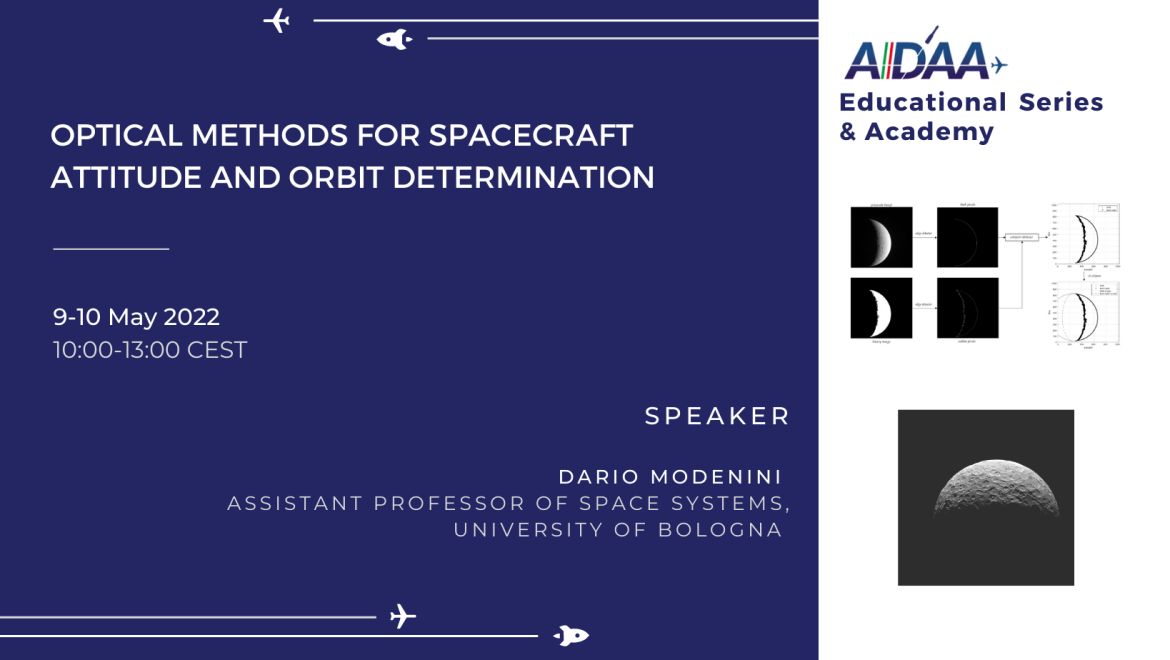
            Optical methods for spacecraft attitude and orbit determination

            Optical methods for spacecraft attitude and orbit determination

            9-10 May 2022, 10:00-13:00 CEST

            Images of celestial bodies collected by a camera contain much valuable information for a spacecraft, which can be used to infer the relative position and/or attitude. Imaging systems have been successfully employed in the past decades to this end, in the form of, e.g., star trackers, navigation cameras, horizon sensors. Depending on the apparent size of the targeted body within the image, different techniques are used to extract the relevant information. In this webinar, the fundamentals of optical navigation techniques will be discussed. Attendees will learn image processing techniques and attitude/position estimation algorithms. Test cases will also be discussed.

            > Download Course Brochure

            Participation

            You need to buy one of the package list available here and use the Order ID assigned to you after purchase.
            You need to Login for registration.

              Courses

              Boosting the commercialisation of space activities

              Boosting the commercialisation of space activities

              26 April 2022, 9:00-13:00 CEST

              This course introduces the market challenges and the business opportunities offered by the emerging space economy.

              > Download Course Brochure

              Participation

              You need to buy one of the package list available here and use the Order ID assigned to you after purchase.
              You need to Login for registration.
                Courses

                Economic assessment of future environmentally sustainable high-speed vehicles

                Economic assessment of future environmentally sustainable high-speed vehicles

                21-22 and 28-29 April 2022, 14:00-16:00 CEST

                Assessing the economic viability of new high-speed concepts since the early design phases is crucial for the success of future hypersonic vehicles including cruisers as well as reusable access-to-space and re-entry systems. Moreover, matching environmentally sustainable innovations guaranteeing at the same time economic sustainability is becoming a key factor. Besides literature reports few parametric cost models for high-speed vehicles, all of them makes exclusive use of mass as a parameter and none of the models moves beyond the vehicle level, thus preventing estimation of the costs associated with subsystems or technologies. This webinar aims at providing the attendees with a cost estimation model which moves beyond the state-of-the-art methodologies (1) by integrating vehicle design and operational parameters (in addition to the mass) as cost drivers for the prediction of the vehicle life-cycle cost, (2) by introducing prediction margins accounting for the uncertainties on the data-driven correlations, (3) by estimating the impact of environmentally sustainable solutions onto the vehicle life-cycle cost, (4) by providing a first estimate of the costs of every onboard subsystem, including combined cycle engines and multi-functional subsystems, (5) by increasing the granularity of the analysis up to technology level, thus providing valuable support to Technology Road-mapping activities, and, eventually, (6) by providing a ticket price estimation to be then compared with the results of a business case. The webinar contains extensive references to high-speed initiatives currently under development in Europe. The presented case studies have been developed and extensively tested in an international context such as the Horizon 2020 STRATOFLY project (2018-2021), the H2020 MORE&LESS project and other ESA funded activities.

                > Download Course Brochure

                Participation

                You need to buy one of the package list available here and use the Order ID assigned to you after purchase.
                You need to Login for registration.

                  Courses

                  Multiscale techniques for nonlinear analysis of composite structures

                  Multiscale techniques for nonlinear analysis of composite structures

                  11/12 April 2022, 14:00-17:00 CEST

                  This course aims to introduce multiscale techniques within the context of nonlinear analysis of composite structures. Failure initiation and propagation in composites is a complex phenomenon and involves multiple length scales. The accurate computational modelling of these processes, therefore, needs to consider the influence of the microstructure on the development of nonlinearities and the subsequent structural response. These considerations are addressed by means of multiscale analysis, where the microstructure is explicitly modelled, leading to a high-fidelity representation of both the material and the structure. The course will focus on numerical techniques used to analyze the microstructure, and the procedures commonly used to interface and transfer information between different length scales. A detailed overview of implementation issues will also be discussed. Finally, some applications and numerical assessments of multiscale techniques will be presented.

                  > Download Course Brochure

                  Participation

                  You need to buy one of the package list available here and use the Order ID assigned to you after purchase.
                  You need to Login for registration.

                    Courses

                    Sound transmission control through optimized composite sandwich lattice panels

                    Sound transmission control through optimized composite sandwich lattice panels

                    06 - 13 - 20 - 27 April 2022, 15:00-17:00 CEST

                    This course provides an overview of recent developments in sound transmission control through aeronautical panel structures. In the first part, general definitions of the sound transmission efficiency parameters are given; moreover, the classical and advanced structural models used to analyze sandwich structures are depicted. In the second part of the course, the attention is focused on recent industrial interests such as 3d-printed lattice materials used for the design of sandwich cores, the homogenization of the lattice material properties is introduced. Furthermore, the passive damping of the multilayered panels can be improved by using soft viscoelastic materials; therefore, their modelling with classical Kelvin-Voigt or fractional derivatives models is explained. In the last part of the course, the structural optimization problem is introduced; the original contributions of the authors define a new particle swarm optimization model called the Population Decline Swarm Optimization method. Finally, some case studies concerning the sound transmission control through optimized multilayered shell composite sandwich panels with lattice core embedding viscoelastic sheets are discussed.

                    > Download Course Brochure

                    Participation

                    You need to buy one of the package list available here and use the Order ID assigned to you after purchase.
                    You need to Login for registration.