Courses

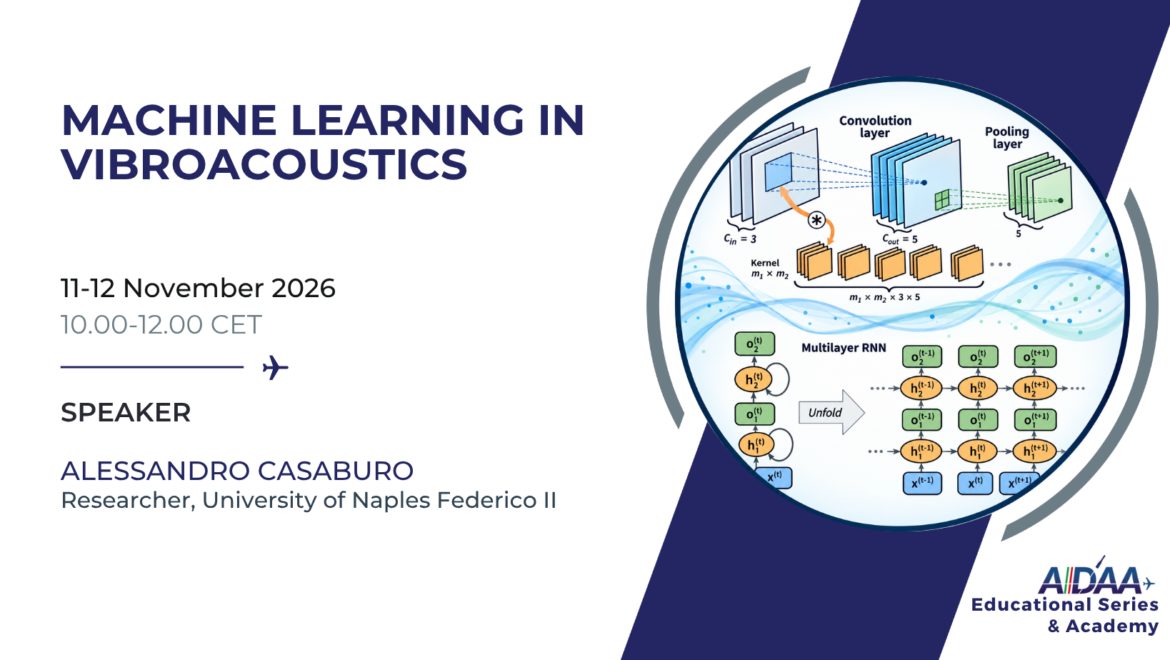
Machine learning in vibroacoustics

Machine learning in vibroacoustics

11-12 November 2026

Syllabus

Overview

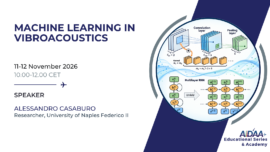
Nowadays, machine learning methods are increasingly used in many engineereing branches, such as mechanical and aerospace, for data analysis, modelling, identification, and prediction. This course provides an introductory overview of machine learning and deep learning methods, with particular emphasis on their application to vibroacoustic problems.
The course first introduces the main concepts of supervised machine learning, including data preparation, training, validation and testing, model evaluation, and overfitting. Artificial neural networks are then presented, starting from multi-layer perceptrons and extending to convolutional and recurrent neural networks. Transformer architectures are introduced at a conceptual level, with particular attention to encoder-based models.
The final part of the course focuses on representative vibroacoustic applications and practical examples implemented in Python using commonly adopted machine-learning libraries.
By the end of the course, participants will be familiar with the main machine learning workflows and neural-network architectures used in engineering applications and will be able to approach basic machine-learning problems using existing Python tools.

Learning objectives

  • Fundamentals of machine learning: supervised learning, data preprocessing, training, validation, testing, overfitting, and model evaluation.
  • Artificial neural networks and the main characteristics of multi-layer perceptrons, convolutional neural networks, recurrent neural networks, and transformers.
  • Basic machine learning workflows implemented in Python using libraries such as Scikit-Learn and PyTorch.

Target Audience

Master students, doctoral students, non-academic professionals

> Download Course Brochure

Participation

You need to buy one of the package list available here and use the Order ID assigned to you after purchase.
You need to Login for registration.
    Courses

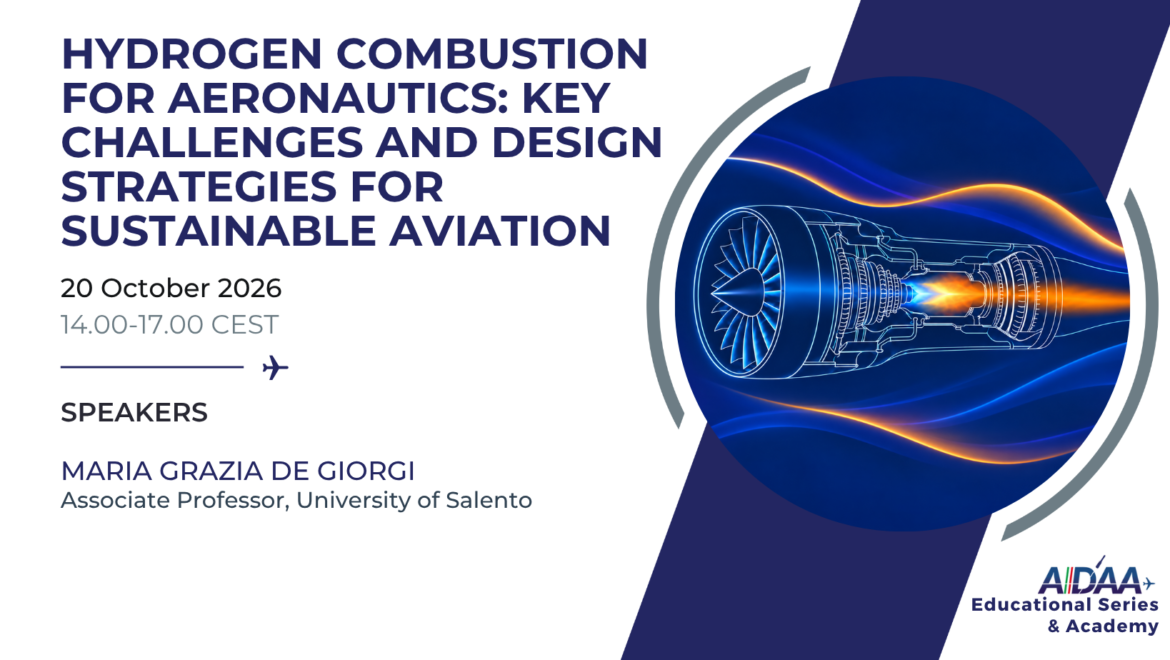
    Hydrogen Combustion for Aeronautics: Key Challenges and Design Strategies for Sustainable Aviation

    Hydrogen Combustion for Aeronautics: Key Challenges and Design Strategies for Sustainable Aviation

    20 October 2026

    Syllabus

    Overview

    This webinar provides a focused introduction to hydrogen combustion for aeronautical propulsion, addressing the main scientific and engineering challenges associated with the use of hydrogen in future aircraft engines. The course is intended to offer a compact but rigorous framework for understanding how hydrogen differs from conventional aviation fuels and how these differences affect combustion behaviour, ignition, emissions, operability, and system integration.
    The webinar covers the main combustion-related properties of hydrogen relevant to aeronautics, including high flame speed, wide flammability limits, low ignition energy, diffusivity, flashback tendency, and NOₓ formation issues under high-temperature conditions. These aspects are linked to practical design implications for combustors and propulsion systems, with emphasis on lean combustion strategies, flame stabilization, ignition reliability, and low-emission operation.
    The course is structured to include both hard technical content and practical engineering reasoning. Participants will be guided through simplified examples comparing conventional and hydrogen-fueled combustion systems, with attention to performance–emissions trade-offs, safety aspects, and aircraft-level integration constraints. A short hands-on section will involve discussion of design-oriented case studies, encouraging participants to reason critically on the opportunities and limitations of hydrogen-powered aviation. The webinar is especially suitable for PhD students, but is also relevant for graduate students, researchers, and professionals interested in sustainable aerospace propulsion.

    Learning objectives

    At the end of the webinar, attendees will be able to:

    • understand the main combustion properties of hydrogen relevant to aeronautics;
    • identify the key technical challenges of hydrogen-fueled aircraft propulsion;
    • explain the main trade-offs between operability, emissions, safety, and performance;
    • apply structured engineering reasoning to simplified hydrogen-combustion case studies.

    Target Audience

    • PhD students in aerospace propulsion, combustion, and energy engineering
    • MSc students interested in sustainable aviation
    • Researchers and professionals working on hydrogen and advanced propulsion systems

    > Download Course Brochure

    Participation

    You need to buy one of the package list available here and use the Order ID assigned to you after purchase.
    You need to Login for registration.

      Courses

      Acoustics in aerospace – Numerical methods and materials characterization

      Acoustics in aerospace – Numerical methods and materials characterization

      13 May 2026

      Syllabus

      Overview

      The aim of this webinar is to deal with the main criticisms related to acoustic simulation and noise suppression in the aerospace sector. This objective is achieved by initially introducing and discussing the state-of-the-art methods and technologies that are relevant to this field. Subsequently, the fundamentals of analytical (Transfer Matrix Method) and numerical (Wave Finite Element Method) approaches are illustrated, which constitute powerful and efficient techniques to estimate the absorption and transmission properties of a sound package. Lastly, some innovative acoustic meta-material configurations are presented, based on a periodic pattern of porous unit cells, whose main homogenization models are defined and discussed too. These topics address different applications not only in the aerospace industry, but more generally in transportation (automotive, railway), energy and civil engineering sectors, where both weight and space, as well as vibroacoustic comfort, still remain as critical issues.

      Learning objectives

      • Aircraft noise: methods and technologies
      • Transfer Matrix and Wave Finite Element Methods in acoustics
      • Acoustic characterization of porous meta-materials

      Target Audience

      Master students, doctoral students, non-academic professionals

      > Download Course Brochure

      Participation

      You need to buy one of the package list available here and use the Order ID assigned to you after purchase.
      You need to Login for registration.

        Congresses and events, Past events

        5th International Conference on Mechanics of Advanced Materials and Structures

        27th AIAA International Space Planes and Hypersonic Systems and Technologies Conference

        1–3 July 2026, Toulouse, France.

        The International Conference on Mechanics of Advanced Materials and Structures (ICMAMS) is a premier scientific event closely associated with the journal Mechanics of Advanced Materials and Structures (MAMS), published by Taylor & Francis. As a flagship initiative of the journal, the conference brings together leading experts, researchers, and professionals from academia and industry to present and discuss the latest advances in the mechanics of advanced materials, smart structures, and computational modeling.

        ICMAMS serves as a dynamic platform for interdisciplinary exchange, fostering collaboration and innovation across areas such as composites, architected materials, nanostructured systems, and multiscale modeling. The conference welcomes contributions that span analytical, numerical, and experimental approaches, as well as emerging themes such as machine learning applications, additive manufacturing, and integrated computational materials engineering.

        With a strong emphasis on cutting-edge research and global engagement, ICMAMS offers participants the opportunity to network with prominent figures in the field, contribute to high-impact discussions, and be part of shaping the future of materials and structural mechanics.

        Congresses and events, Past events

        27th AIAA International Space Planes and Hypersonic Systems and Technologies Conference

        27th AIAA International Space Planes and Hypersonic Systems and Technologies Conference

        7-10 July 2026, Napoli

        The 27th AIAA International Space Planes and Hypersonic Systems and Technologies Conference, jointly organized with the Italian Association of Aeronautics and Astronautics (A.I.D.A.A), will provide a forum for discussion and exchange of information for attendees from across the globe about leading edge research and development activities associated with space planes and hypersonic atmospheric flight vehicles and the technologies underpinning these capabilities. Presentations will be provided on national programs from Europe, North America, South America, Australia, and Asia and multiple opportunities for international collaboration will be discussed. Technical paper topics include planned and ongoing space plane and hypersonic vehicle programs, advanced launch vehicle and hypersonic atmospheric flight vehicle concepts, commercial space tourism concepts, ground and flight testing techniques, results, and lessons learned, reentry vehicle systems and technologies, aerodynamics and aerothermodynamics of space planes and hypersonic vehicles, guidance and control systems, rocket, ramjet, scramjet, and other advanced propulsion systems, including component technologies (e.g., inlets, combustion systems, fuel injection concepts, ignition and flameholding concepts, nozzles), high-temperature materials, hot structures and thermal protection systems, health monitoring and management technologies, and more. Special panel sessions will be organized around relevant topics of strong global interest.

        Courses

        Advanced Structural Theories and Modelling Guidelines for Composite Structures

        Advanced Structural Theories and Modelling Guidelines for Composite Structures

        24 November 2025

        Composites’ design cannot use extensions of the methodologies adopted for metals. Such a strategy may lead to oversizing, let alone the risks arising from a wrong design. Composites are more complex material systems than metals due to their multiscale nature. Brittle orthotropic fibers, ductile isotropic matrices, and soft cores coexist.  Such complexity leads to challenging predictive models, e.g., to detect composite structures’ damage and failure mechanisms, which is still far from reliable predictions via virtual models and needs high computational costs, precluding structural engineering calculations. Uncertainties in the models lead to safety factors and tests. Therefore, the full spectrum of composites’ advantages is not exploitable, and costly experimental tests are necessary.

        This webinar reviews the mechanical behavior of composites and highlights modeling challenges. It highlights limitations of standard finite element techniques and presents approaches to improving solutions. It also introduces structural theories and detailed methods for developing them. Numerical examples concerning linear analysis, failure index evaluations, and structural dynamics provide guidelines on the proper modeling. Extensions to nonlinear analysis, process simulation, and multiscale analyses are also presented.

        Learning objectives:

        • Mechanical behavior of composite structures
        • Review of theories of structures
        • Structural theories for composites
        • 1D and 2D finite elements
        • Guidelines for modeling
        • Basics of multifield analysis, multiscale modeling, failure analyses, and process simulation

        Target audience: doctoral students, non-academic professionals, and undergraduate students.

        > Download Course Brochure

        Participation

        You need to buy one of the package list available here and use the Order ID assigned to you after purchase.
        You need to Login for registration.

          Courses

          Recent research in vibration testing of aerospace hardware

          Recent research in vibration testing of aerospace hardware

          14 November 2025

          Overview and General Information:

          Dynamic testing is essential in the design and qualification of aerospace hardware. It serves diverse purposes, from characterizing dynamic responses at different system levels to evaluating hardware performance under operational loads. Vibration testing is fundamental for correlating and updating numerical models used in aerospace product design and validation. Environmental dynamic testing aims at replicating real conditions, such as in-flight or transport scenarios, in laboratory settings to ensure systems will perform as expected throughout their operational lifetime. With the emergence of disruptive aerospace systems and increasingly competitive markets, the industry demands innovations in practices that have remained mostly unchanged for decades.

          This webinar presents recent advances in dynamic testing of aerospace hardware. It provides an overview of the topic and explores key innovations that address industry demands. The presentation covers various testing practices including vibration control, multi-axis testing, shock testing, virtual shaker technology, ground vibration testing, and flight testing. Additionally, it describes how digital twins can improve and de-risk test campaigns in these applications.

          Learning Objectives:

          • Overview of dynamic testing practices of aerospace hardware
          • Vibration testing in shaker platforms: current practices and new trends
          • Testing of aircraft structures: from GVT to flight testing
          • The role of Digital Twins in dynamic testing

          Target audience

          Master’s students, doctoral students, academic and non-academic professionals

          > Download Course Brochure

          Participation

          You need to buy one of the package list available here and use the Order ID assigned to you after purchase.
          You need to Login for registration.

            Courses

            Deep Learning and Computer Vision for Spacecraft Navigation

            Deep Learning and Computer Vision for Spacecraft Navigation

            14-17 October 2025

            The course offers a thorough overview on the emerging topic of deep learning for computer vision and egomotion estimation. Such technique is extremely useful to carry out the task of spacecraft relative navigation in proximity operations, e.g. during planetary approaches, landing or rendezvous. The course is intended to provide a solid theoretical knowledge together with the exploration of the latest state-of-the-art techniques.

            The seminar is organized in lectures, demos and small workshops. Lectures are passive (from the student’s point of view). Demo sessions are used to demonstrate and run state-of-the-art implementation of some algorithms. Workshop sessions are used to get acquainted with the most famous CV and DL libraries (openCV, pyTorch, etc.).

            Learning objectives: Introduction to Computer Vision, Introduction to Deep Learning, Convolutional Neural Networks, Multi-view geometry and Relative Navigation

            Target audience: doctoral and master students, non-academic professionals.

            > Download Course Brochure

            Participation

            You need to buy one of the package list available here and use the Order ID assigned to you after purchase.
            You need to Login for registration.

              Courses

              Nonlinear spacecraft attitude control

              Nonlinear spacecraft attitude control

              22/24 September 2025

              Spacecraft attitude equations are usually given by nonlinear equations. However, spacecraft attitude control laws are often designed using a linear approximation of those equations about an operating condition. Thus, the effectiveness of the control laws can be guaranteed only for attitude angles and angular velocities close to the operating condition. There are occasions when the spacecraft motion involves attitude angles and angular velocities that are far from the operating condition. For those motions, the full nonlinear attitude equations must be used for evaluating the effectiveness of the control laws. This course presents the design of attitude control laws for two typical spacecraft operations along with basic tools that are useful to validate the design with nonlinear attitude equations.

              Learning objectives: Learning control laws for spacecraft detumbling and spacecraft attitude regulation. Learning mathematical tools for validating attitude control laws using nonlinear attitude equations.

              Target audience: doctoral and master students, non-academic professionals.

              > Download Course Brochure

              Participation

              You need to buy one of the package list available here and use the Order ID assigned to you after purchase.
              You need to Login for registration.

                Courses

                Acoustics in aerospace – Numerical methods and materials characterization

                Acoustics in aerospace – Numerical methods and materials characterization

                17 February 2025

                Overview and General Information:

                The aim of this webinar is to deal with the main criticisms related to acoustic simulation and noise suppression in the aerospace sector. This objective is achieved by initially introducing and discussing the state-of-the-art methods and technologies that are relevant to this field. Subsequently, the fundamentals of analytical (Transfer Matrix Method) and numerical (Wave Finite Element Method) approaches are illustrated, which constitute powerful and efficient techniques to estimate the absorption and transmission properties of a sound package. Lastly, some innovative acoustic meta-material configurations are presented, based on a periodic pattern of porous unit cells, whose main homogenization models are defined and discussed too. These topics address different applications not only in the aerospace industry, but more generally in transportation (automotive, railway), energy and civil engineering sectors, where both weight and space, as well as vibroacoustic comfort, still remain as critical issues.

                Learning Objectives:

                • Aircraft noise: methods and technologies
                • Transfer Matrix and Wave Finite Element Methods in acoustics
                • Acoustic characterization of porous meta-materials

                > Download Course Brochure

                Participation

                You need to buy one of the package list available here and use the Order ID assigned to you after purchase.
                You need to Login for registration.