Congresses and events, Past events

IAC 2024

IAC 2024

11-18th October 2024, Milan

More than 8,000 experts from industry, research, and institutions will attend the 75th International Astronautical Congress (IAC) from 14-18 October 2024 in Milan, placing Italy at the forefront of the international discussion on how space can be used to promote sustainability.

The city of Milano will host the 75th edition of the International Astronautical Congress IAC2024, the most important world event in the space sector. Milan being selected by the more than 400 delegates of the General Assembly of the International Astronautical Federation from 73 countries of the world and gathered in Dubai from 25 to 29 October for the 72nd edition of the IAC2021.

AIDAA President and Local Chairman of IAC 2024 Erasmo Carrera’s welcome greetings are available here.

Congresses and events, Past events

ICAS 2024

ICAS2024

9-13th September 2024, Florence

ICAS is the international organization of aeronautical engineering societies with members from 30 countries. The International Congress is every two years and covers all aspects of aeronautical science and technology and applications to aviation. ICAS 2024 is scheduled from 9 to 13 September 2024 in Florence.

Congresses and events, Past events

AIAA/CEAS Aeroacoustics Conference

AIAA/CEAS Aeroacoustics Conference

4-7th June 2024, Rome

AIDAA is glad to announce that the 30th AIAA/CEAS Aeroacoustics Conference (Aeroacoustics 2024) will be held in Rome from 4 to 7th June 2024. The Conference represents the premier international forum for the field of aeroacoustics and provides an exceptional opportunity for scientists and engineers from industry, government, and academia to exchange knowledge and results of current studies and to discuss directions for future research.

Congresses and events, Past events

6° edizione del Premio in memoria del Prof. Franco Persiani

6° Edizione del Premio in memoria del Prof. Franco Persiani

31 July 2024, Forlì, Italy

L’AIDAA annuncia la pubblicazione del bando della 6° edizione del Premio in memoria del Professore Franco Persiani, di cui è promotrice unitamente al Centro Studi Franco Persiani e a Serinar. Il premio è destinato a laureati in Ingegneria Aerospaziale o Aerospace Engineering in qualsiasi Università italiana che hanno discusso la propria tesi di laurea magistrale sul tema “Innovazione per il settore aeronautico”  nel periodo dal 1 ottobre 2023 al 31 luglio 2024. La scadenza per presentare le domande è fissata al 31 luglio 2024. 

Il prof. Persiani è stato dal 2009 al 2013 presidente dell’AIDAA.

Maggiori informazioni sul premio e sul bando possono essere trovate qui.

Congresses and events, Past events

European Business Aviation Convention & Exhibition EBACE2024

European Business Aviation Convention & Exhibition EBACE2024

28-30 May 2024, Geneva, Switzerland

The 2024 European Business Aviation Convention & Exhibition (EBACE2024), Europe’s premier on-demand aircraft and advanced air mobility event is taking off at the magnificent Palexpo in Geneva, Switzerland, and the Geneva International Airport from Tuesday 28 May through Thursday 30 May 2024.

The EBACE is a premier event and the annual meeting place for the European business aviation community. The exhibition brings together business leaders, government officials, manufacturers, flight department personnel, avionics firms, fractional providers, charter/lease companies and all manner of people involved in nearly every aspect of business aviation.

PhD Days

4th Aerospace PhD-Days

4th Aerospace PhD-Days

6 - 9 May 2024, Scopello (TP)

The fourth edition of the Aerospace PhD-Days will be held in Scopello (TP), Sicily, from the 6th to the 9th of May 2024.

During the congress, PhD students will have the possibilities to share their activities to the colleagues all over the world and, thus, to create a net of the International young researchers; moreover, it will be possible to have a complete overview of the whole research activities in Aerospace.

The Aerospace PhD-Days are open to any PhD student in Aerospace Science and Engineering or with a PhD topic in the aerospace field. PhD graduated in 2024 are welcomed too. In order to participate, an extended abstract (4 pages) on the PhD topic or part of it must be submitted.

The main topics will be related to aeronautics, space, and aviation.

Courses

Identification and non-destructive characterization of defects and damage in aerospace composite structures

Identification and non-destructive characterization of defects and damage in aerospace composite structures

23/25 January 15-18 CET

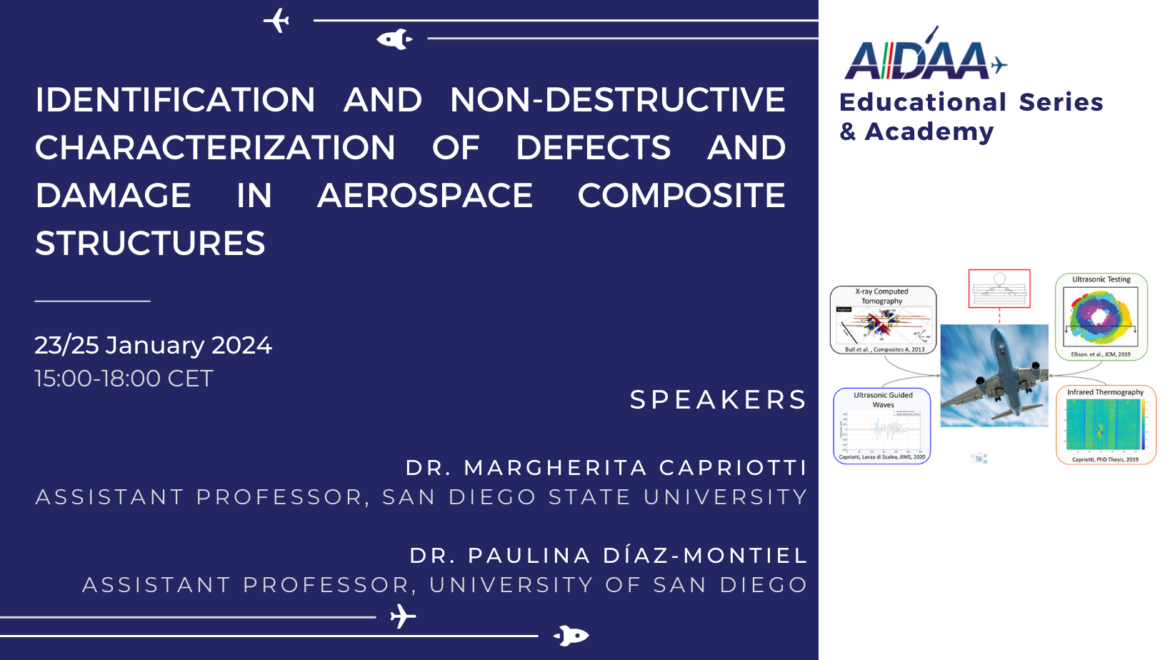
Fiber-reinforced polymeric (FRP) composites are high-performance materials used in the aerospace industry due to their excellent fatigue resistance, durability, and high stiffness- and strength- to weight ratios. Composites allow the design of lightweight structures with tailorable properties that minimize energy usage and contaminant emissions. These materials are currently utilized in fuselages, wings, tails, doors, and interiors of modern aerospace structures.

Despite the excellent mechanical properties, adoption and certification of composite aerospace structures is a challenge primarily due to (1) the current knowledge gap in the technology, manufacturing, process-induced defects, maintenance and repair methods for aerospace-grade FRP composites, and (2) the complex and highly varying behavior and damage formation/evolution of these materials.

This course discusses some of the main challenges for the use of composite materials in aerospace applications, emphasizing four main aspects: manufacturing defects and signatures, identification of defects via non-destructive evaluation (NDE) methods, effect of defects on the mechanical performance, and NDE for assessment of structural integrity.

The current manufacturing techniques for fabricating aerospace-grade FRP composite structures are discussed. The common defects associated with these methods (e.g., fiber and ply waviness, voids/porosity, inclusions, resin-rich regions) are reviewed, and the effect of these manufacturing defects on the strength and life of composite structures is analyzed. The state-of-the art techniques for identifying and characterizing defects in aerospace structural components using NDE methods are discussed, giving particular attention to ultrasonic testing, guided waves, infrared thermography and X-Ray computed tomography. Finally, the current challenges for assessing structural integrity of aerospace composite structures via NDE techniques are presented and the main areas of opportunity in this field are highlighted.

MODULE 1 – Manufacturing Defects and Signatures (90 minutes)

  1. Overview of composite materials systems used in the aerospace industry.
  2. Manufacturing processes for aerospace composite materials.
  3. Defects developed during the manufacturing processes.

MODULE 2 – Non-destructive Evaluation Methods (90 minutes)

  1. Non-destructive evaluation (NDE) techniques for the detection and characterization of defects in the aerospace industry.

MODULE 3 – Effect of Defects (90 minutes)

  1. Experimental and modeling approaches for predicting the effect of defects on the damage modes and mechanical performance of composites.

MODULE 4 – Structural Integrity Assessment using NDE Methods (90 minutes)

  1. Damage developed in composites during operational life.
  2. NDE methods for assessment of structural integrity of composite structures.

Learning objectives

At the end of this course, the attendees should be able to:

  1. Explain the difference between thermoplastic and thermoset polymer systems, in terms of the microstructure and mechanical properties.
  2. List the main applications of carbon fiber reinforced polymeric (CFRP) composites in aerospace structural components.
  3. Explain the different manufacturing methods for fabricating aerospace-grade composite materials, and identify the advantages and disadvantages of each of these techniques.
  4. Describe the common defects in CFRP composites developed during the manufacturing.
  5. Describe the needs, constraints and outcomes of NDE inspections in the aerospace field.
  6. Understand the physical principles and basic implementation of the presented NDE techniques (i.e., ultrasonic testing, ultrasonic guided waves, infrared thermography, X-ray computed tomography).
  7. Assess the effect of manufacturing defects on the mechanical properties, strength and life of composite structures.
  8. Describe damage formation and/or evolution in CFRP due to fatigue, impacts and environmental conditions.
  9. Assess advantages and limitations of NDE techniques with respect to specific defects and damages in the aerospace field.

Target audience: undergraduate, graduate and doctoral students, academic and non-academic professionals. CTNA-Cluster Exploore Marche members.

> Download Course Brochure

Participation

You need to buy one of the package list available here and use the Order ID assigned to you after purchase.
You need to Login for registration.

    Courses

    Numerical modelling of hypersonic flows

    Numerical modelling of hypersonic flows

    13 December 9-18 CEST

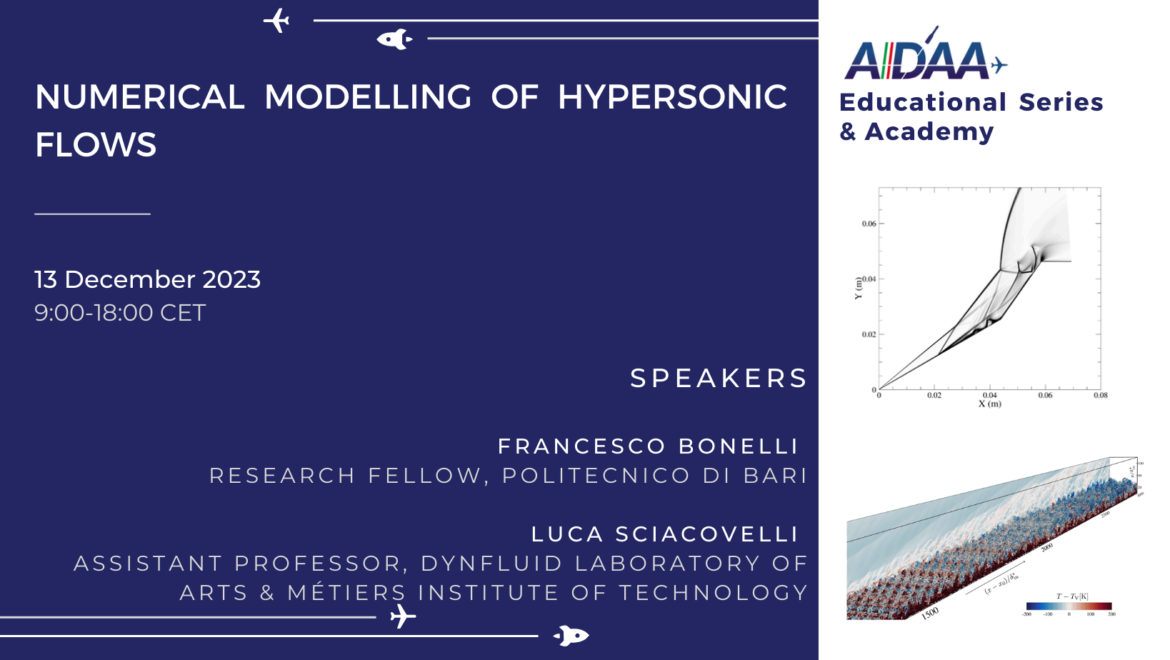
    This webinar Introduces the fundamentals of thermochemical modeling and numerical simulation of high-temperature hypersonic flows in the laminar and turbulent regimes.

    Syllabus

    • Introduction to hypersonic flows
    • Properties and thermophysical modeling of high-temperature flows
    • Compressibility effects on high-speed turbulence
    • Classical shock-capturing schemes
    • High-order numerical schemes for compressible turbulent flows

    Target audience

    This webinar is addressed to graduate/undergraduate engineering students, aerospace Ph.D. students.

    > Download Course Brochure

    Participation

    You need to buy one of the package list available here and use the Order ID assigned to you after purchase.
    You need to Login for registration.
      Congresses and events, Past events

      SESAR Young Scientist Award 2023

      SESAR Young Scientist Award 2023

      27-30 November, Sevilla, Spain

      Are you a young scientist active in the field of air traffic management (ATM) and aviation? Are you looking for the perfect opportunity to showcase your talent and advance your career? If yes, then look no further… the SESAR Young Scientist Award is for you!

      The SESAR Young Scientist Award recognises young scientists, who have demonstrated excellence in ATM and aviation-related research fields. The award also provides researchers starting out in their career with an opportunity for further professional development.

      A further objective of the award is to showcase the potential of young talent to formulate fresh ideas and solutions to the challenges facing ATM and aviation.

      The 2023 edition of the award has widened its scope from previous years and is now open to two categories:

      • PhD scientists; with the chance to receive a prize of EUR 5 000
      • Undergraduate or Master students; with the chance to win a prize of EUR 1 500

      Contributions are welcome from citizens or residents in an EU Member State or an Associated Country to the Horizon Europe Research and Development Framework Programme (Horizon Europe).

      Up to three short-listed candidates for each category will be invited to join the SESAR Innovation Days 2023 from 27-30 November in Sevilla, where the winner of each category will be publicly announced during a dedicated ceremony.

      The deadline for applications is 8 September 2023, 24.00 CET

      More info here.

      Courses

      Tethers in Space: deorbiting and power generation

      Tethers in Space: deorbiting and power generation

      20 November 10-12 CEST

      The Space Tether consists of a complex structure where there are three main parts: 1) the primary satellite; 2) a secondary
      satellite; 3) a cable (of variable lengths) that is used to join the two spacecraft together. This cable allows the transfer of energy and momentum between the two spacecraft, and this transfer can be present in both directions and, in some cases,
      can switch direction. Space tethers can be classified into two different areas: Passive tethers, which are used simply for mechanical connection and mainly transfer momentum from one part to the other; and Electrodynamic tethers, conductive wires or tapes or more complex structures), in which an electric current can flow and pass from one end to the other. The simplest application involves using the tether system as a de-orbit system; a drag Force is induced on the tether due to its relative motion with respect to the rotating plasma and the satellite.
      An opposite application is the injection of electric current from one satellite which has an effect opposite to the deorbiting;
      this effect can be used to increase the SMA of the system or produce movements in the orbital plane. The Electrodynamic tether is a system that can act as an orbital control for small and relatively big structures (depending on the tether length and on the produced current). Even if the tethers’ dynamics (passive or electrodynamic) are complex and not at all completely understood, the current knowledge in materials and technology is bridging the gap between theory and extensive application in current Space missions.

      > Download Course Brochure

      Participation

      You need to buy one of the package list available here and use the Order ID assigned to you after purchase.
      You need to Login for registration.