Congresses and events, Past events

SESAR Young Scientist Award 2023

SESAR Young Scientist Award 2023

27-30 November, Sevilla, Spain

Are you a young scientist active in the field of air traffic management (ATM) and aviation? Are you looking for the perfect opportunity to showcase your talent and advance your career? If yes, then look no further… the SESAR Young Scientist Award is for you!

The SESAR Young Scientist Award recognises young scientists, who have demonstrated excellence in ATM and aviation-related research fields. The award also provides researchers starting out in their career with an opportunity for further professional development.

A further objective of the award is to showcase the potential of young talent to formulate fresh ideas and solutions to the challenges facing ATM and aviation.

The 2023 edition of the award has widened its scope from previous years and is now open to two categories:

  • PhD scientists; with the chance to receive a prize of EUR 5 000
  • Undergraduate or Master students; with the chance to win a prize of EUR 1 500

Contributions are welcome from citizens or residents in an EU Member State or an Associated Country to the Horizon Europe Research and Development Framework Programme (Horizon Europe).

Up to three short-listed candidates for each category will be invited to join the SESAR Innovation Days 2023 from 27-30 November in Sevilla, where the winner of each category will be publicly announced during a dedicated ceremony.

The deadline for applications is 8 September 2023, 24.00 CET

More info here.

Courses

Tethers in Space: deorbiting and power generation

Tethers in Space: deorbiting and power generation

20 November 10-12 CEST

The Space Tether consists of a complex structure where there are three main parts: 1) the primary satellite; 2) a secondary
satellite; 3) a cable (of variable lengths) that is used to join the two spacecraft together. This cable allows the transfer of energy and momentum between the two spacecraft, and this transfer can be present in both directions and, in some cases,
can switch direction. Space tethers can be classified into two different areas: Passive tethers, which are used simply for mechanical connection and mainly transfer momentum from one part to the other; and Electrodynamic tethers, conductive wires or tapes or more complex structures), in which an electric current can flow and pass from one end to the other. The simplest application involves using the tether system as a de-orbit system; a drag Force is induced on the tether due to its relative motion with respect to the rotating plasma and the satellite.
An opposite application is the injection of electric current from one satellite which has an effect opposite to the deorbiting;
this effect can be used to increase the SMA of the system or produce movements in the orbital plane. The Electrodynamic tether is a system that can act as an orbital control for small and relatively big structures (depending on the tether length and on the produced current). Even if the tethers’ dynamics (passive or electrodynamic) are complex and not at all completely understood, the current knowledge in materials and technology is bridging the gap between theory and extensive application in current Space missions.

> Download Course Brochure

Participation

You need to buy one of the package list available here and use the Order ID assigned to you after purchase.
You need to Login for registration.

    Courses

    The Space Environment Interaction Engineering: Physics, Test Technology and Experimental Validation

    The Space Environment Interaction Engineering: Physics, Test Technology and Experimental Validation

    13/15/17 November 10-12 CEST

    Overview and General Information:

    In order to use space for scientific and commercial purposes it is necessary to understand the Low Earth Orbit (LEO) space environment where most of the activities are now, and will be in the future, carried out. LEO environment includes severe hazards such as Atomic Oxygen (AO), Ultraviolet (UV) Radiation, Ionizing Radiation, High Vacuum, Plasma, Micrometeoroids and Debris, Severe Temperature Cycles and, for some systems, the Re-Entry Environment. It is important to note that these environmental characteristics do affect the space systems, the materials and the structures at the same time, with a remarkable synergistic effect. In order to understand these synergistic effects, whether experimental or theoretical and numerical approaches are of essential importance, as the comprehension of the operative environment becomes a key point to extend operative life of satellites and structures and to withstand aggressive conditions.

    The course is based on the analysis of the physics of Space Environment and it is completed with an in-depth analysis of both ground testing methods and the validation of experimental tests according to current regulations given by the major agencies as ESA and NASA.

    Syllabus

    • Part 1: Physics of the Space Environment (2 hours)
    • Part 2: Test Technology, Ground-Test Facilities (2 hours)
    • Part 3: Experimental Validation (2 hours)

    Learning Objectives:

    Aim of the course is to give to the attendee the instruments to understand both the Space Environment and the related techniques for Environmental Tests on Space Systems, Materials and Structures.

    Target audience

    The course is dedicated to Ph.D students, non-academic professionals and undergraduate students.

    > Download Course Brochure

    Participation

    You need to buy one of the package list available here and use the Order ID assigned to you after purchase.
    You need to Login for registration.

      Courses

      Nonlinear spacecraft attitude control

      Nonlinear spacecraft attitude control

      6/8 November 2023

      Overview and General Information: 

      Spacecraft attitude control laws are often designed using linear control design techniques. As a result, their effectiveness can be guaranteed only for small attitude angles and small angular velocities since in that situation a linear approximation of the attitude equations can be employed. However, there are occasions when the spacecraft motion involves large attitude angles and large angular velocities. For those motions, the full nonlinear attitude equations must be used for evaluating the effectiveness of attitude control laws. In this course, basic results of Lyapunov stability theory will be presented and applied to nonlinear spacecraft attitude control.

      Learning objectives: 

      • Spacecraft detumbling
      • Stability of nonlinear systems
      • Lyapunov theorems
      • Nonlinear spacecraft attitude stabilization
      • La Salle’s theorem
      • Lyapunov indirect method

      Target audience

      Doctoral students, non-academic professionals.

      > Download Course Brochure

      Participation

      You need to buy one of the package list available here and use the Order ID assigned to you after purchase.
      You need to Login for registration.

        Courses

        Weapons bay aerodynamics and acoustic

        Weapons bay aerodynamics and acoustic

        20 October 2023

        Overview and General Information: 

        Modern combat aircraft design requirements impose the adoption of weapons bays to reduce radar signature and aerodynamic drag at transonic/supersonic speeds. Nevertheless, upon opening the bay, to release the store, aerodynamics and acoustic issues are generated which may potentially damage the structure of the cavity and the gimbal/sensors of the ordnance. Additionally, the trajectory of the store is strongly coupled to the unsteadiness of the aerodynamic field posing a hazard to a safe separation. Successful designs have been employed in current, low-signature,combat aircraft generation (F22, F117, F35, B2, J20, Su57), though each new design requires detailed studies to optimise the final architecture. In this webinar, the fundamentals of weapons bays aerodynamics and acoustic will be discussed.Attendees will learn to identify the major issues characterizing the topic, and what are the main difficulties during store release procedures. Numerical and experimental approaches for design procedures will be discussed as well.

        Learning objectives: 

        • Definition of main design challenges
        • Design approach and common solutions (including palliatives)
        • Fundamentals of store release
        • Examples of numerical and experimental approaches

        Target audience

        Doctoral students, non-academic professionals.

        > Download Course Brochure

        Participation

        You need to buy one of the package list available here and use the Order ID assigned to you after purchase.
        You need to Login for registration.

          Congresses and events, Past events

          5° edizione del Premio in memoria del prof. Franco Persiani

          5° Edizione del Premio in memoria del Prof. Franco Persiani

          31 October 2023, Forlì, Italy

          L’AIDAA annuncia la pubblicazione del bando della 5° edizione del Premio in memoria del Professore Franco Persiani, di cui è promotrice unitamente al Centro Studi Franco Persiani e a Serinar. Il premio è destinato a laureati in Ingegneria Aerospaziale o Aerospace Engineering in qualsiasi Università italiana che hanno discusso la propria tesi di laurea magistrale sul tema “Innovazione per il settore aeronautico”  nel periodo dal 1 ottobre 2022 al 30 settembre 2023. La scadenza per presentare le domande è fissata al 31 ottobre 2023. 

          Il prof. Persiani è stato dal 2009 al 2013 presidente dell’AIDAA.

          Maggiori informazioni sul premio e sul bando possono essere trovate qui.

          Courses

          Sensors and actuators for aerospace applications

          Sensors and actuators for aerospace applications

          12 September 2023

          Overview and General Information:

          Sensors and actuators are important for a variety of applications, such as control systems, robotics, mechatronic systems, biomedical devices, and aerospace. This seminar covers the fundamental physical principles, characteristics, and applications for various types of sensors and actuators including thermal, mechanical, electrical, electromechanical, and optical. After an introductory discussion on sensors and actuators, the focus will be on aerospace applications, where selected examples will be analyzed.

          Learning Objectives:

          • Introduction to sensors
          • Sensors’ characteristics
          • Physical principle of sensors
          • Analysis of different sensors (e.g. piezoelectric, indictive, capacitive, optical, etc.)
          • Actuators
          • Aerospace applications: case studies

          Seminar Learning Outcome

          1. Be able to recognize and calculate sensors’ characteristics for different sensors such as pressure, temperature, strain, level sensors, etc.
          2. Understand fundamental physics and constitutive laws for several common transducer types including electromagnetic, piezoelectric, and thermoelectric.
          3. Be able to apply and use sensing physics to design and analyze sensors and actuators.


          Target audience

          Undergrad and grands students are welcomed.

          > Download Course Brochure

          Participation

          You need to buy one of the package list available here and use the Order ID assigned to you after purchase.
          You need to Login for registration.

            Congresses and events, Past events

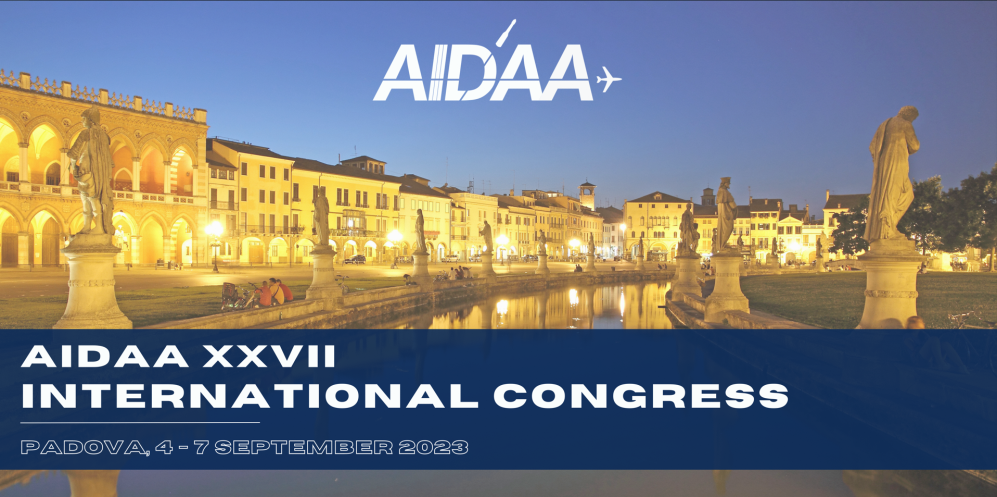
            AIDAA XXVII International Congress

            AIDAA XXVII International Congress

            4 - 7 September 2023, Padova

            The Italian Association of Aeronautics and Astronautics (A.I.D.A.A.) XXVII International Congress will be held in Padova from the 4th to the 7th of September 2023.

            The AIDAA Congress is the biennial congress of the Associazione Italiana di Aeronautica ed Astronautica and it is the 27th in the Congress series. The AIDAA Congress brings together an international community of academics and industry professionals to discuss the latest findings in aeronautics and astronautics sciences and technologies. The AIDAA 2023 technical program will include plenary and parallel sessions, keynote speeches, mini-symposia and other events.

            Courses

            Toward Smart Air Mobility: a Model-Based Design approach

            Toward Smart Air Mobility: a Model-Based Design approach

            20-21 July 2023

            Overview and General Information:

            The interest in Urban Air Mobility (UAM) had a step increase over the last few years. On the one hand, the slow growth rate of ground infrastructures led to a critical congestion in urban areas. On the other hand, the increasing demand for moving people and payloads further and faster drove the attention of research community and stakeholders toward the exploitation of the vertical dimension. With the aim to play a lead role in this new raising market, electrical air platforms with vertical take-off and landing (VTOL) capabilities are being considered as key elements for the next generation of controlled airspace. In such a framework, crucial but challenging steps are represented by the optimization of novel configurations and the design of Guidance, Navigation, and Control systems. In this webinar, the fundamentals of Model-Based Design (MBD) approach will be discussed and applied to VTOL platforms. Attendees will learn the workflow of MBD and investigate the steps required for performance optimization and motion stabilization of rotary-wing vehicles. Test cases will be also presented.

            Learning objectives

            • Fundamentals of MBD method.
            • Application of MBD approach to a sample test-case.
            • Optimal sizing and performance estimation of rotary-wing aircraft.

            > Download Course Brochure

            Participation

            You need to buy one of the package list available here and use the Order ID assigned to you after purchase.
            You need to Login for registration.

              Courses

              Introduction to peridynamics

              Introduction to peridynamics

              10-13 July 2023

              Overview and General Information:

              The nonlocal peridynamic theory provides the capability for improved modeling of progressive failure in materials and structures.  This course starts with an overview of the Peridynamic (PD) theory and derivation of its governing equations based on the balance laws of classical continuum mechanics.  Subsequently, it presents derivation of the PD differential operator (PDDO) which enables the PD form of the governing equations of classical continuum mechanics. This course presents not only the theoretical basis but also its numerical implementation for the solution of governing field equations.

              Learning Objectives:

              The primary objective of the course is to acquaint students with the concept of PD, and derivation of the bond-based and state-based PD equilibrium equations through the Euler-Lagrange equations.  Also, it acquaints the students with the derivation of PD differential operator, and its use in the construction of governing equations for elastic and elastic-plastic material response as well as the coupling of PD with the finite element analysis.

              > Download Course Brochure

              Participation

              You need to buy one of the package list available here and use the Order ID assigned to you after purchase.
              You need to Login for registration.