

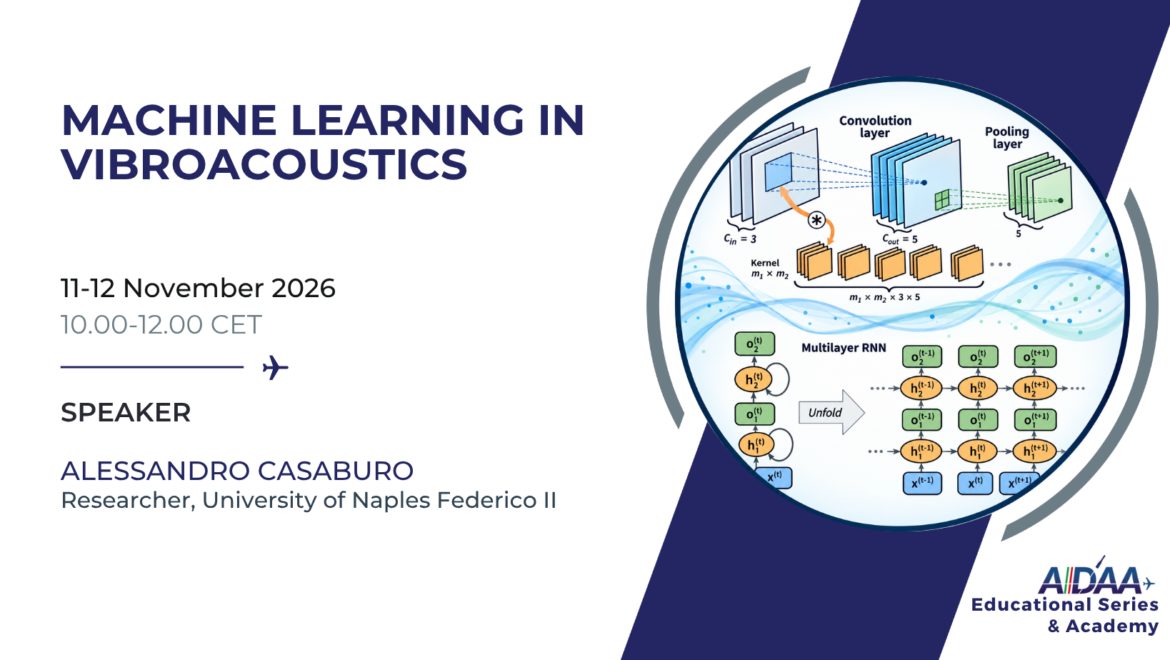
Machine learning in vibroacoustics
11-12 November 2026
Syllabus
Overview
Nowadays, machine learning methods are increasingly used in many engineereing branches, such as mechanical and aerospace, for data analysis, modelling, identification, and prediction. This course provides an introductory overview of machine learning and deep learning methods, with particular emphasis on their application to vibroacoustic problems.
The course first introduces the main concepts of supervised machine learning, including data preparation, training, validation and testing, model evaluation, and overfitting. Artificial neural networks are then presented, starting from multi-layer perceptrons and extending to convolutional and recurrent neural networks. Transformer architectures are introduced at a conceptual level, with particular attention to encoder-based models.
The final part of the course focuses on representative vibroacoustic applications and practical examples implemented in Python using commonly adopted machine-learning libraries.
By the end of the course, participants will be familiar with the main machine learning workflows and neural-network architectures used in engineering applications and will be able to approach basic machine-learning problems using existing Python tools.
Learning objectives
- Fundamentals of machine learning: supervised learning, data preprocessing, training, validation, testing, overfitting, and model evaluation.
- Artificial neural networks and the main characteristics of multi-layer perceptrons, convolutional neural networks, recurrent neural networks, and transformers.
- Basic machine learning workflows implemented in Python using libraries such as Scikit-Learn and PyTorch.
Target Audience
Master students, doctoral students, non-academic professionals
Participation
You need to buy one of the package list available here and use the Order ID assigned to you after purchase.
You need to Login for registration.